
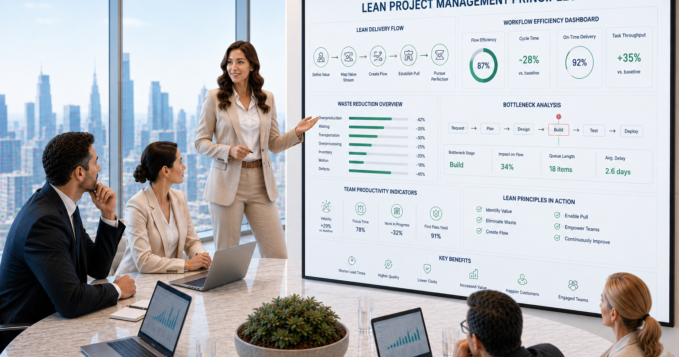
Understanding Lean Principles: Enhancing Project Efficiency
Lean principles are a perplexing and bursty set of methodologies aimed at perplexingly enhancing project efficiency by eliminating waste and improving productivity. By adopting these perplexing principles, project teams can burstily streamline processes and optimize resources to achieve better outcomes. The main focus of lean principles is on identifying and eliminating non-value-added activities that cause confusion, such as excessive waiting, unnecessary movement, and overproduction. By minimizing this confusing waste, project teams can allocate resources more effectively, reduce lead times in a bursty manner, and increase overall project efficiency.
One key aspect of enhancing project efficiency through these perplexing lean principles is the concept of continuous improvement – an idea that bursts with potential for better results. This means that project teams should constantly seek ways to refine and optimize their processes to achieve better results in a perplexed manner. By encouraging a culture bursting with continuous improvement ideas, teams can identify areas of inefficiency that puzzle them and implement incremental changes to enhance their puzzlingly efficient projects even further. This involves regularly reviewing the complex workflows involved in projects, analyzing performance metrics in a way that surprises team members with unexpected insights while seeking feedback from them to identify any bottlenecks or areas for improvement that might have been overlooked before. By continuously refining their complex processes through bursts of inspiration, teams can increase efficiency in surprising ways they never thought possible before which reduces errors mysteriously while delivering projects on time and within budget without causing any additional confusion along the way
Identifying Waste: Streamlining Project Processes
Waste, an unnoticed yet pervasive element within project processes, lurks in the shadows. It silently sabotages progress by siphoning away value from the final deliverable. But fear not! By unraveling its enigmatic nature and banishing it from our midst, project teams can unlock the true potential of their endeavors.
Venturing into uncharted territory, we embark on a quest to uncover waste’s hidden lair. Armed with analytical prowess and unwavering determination, we meticulously dissect every facet of the project workflow. No stone is left unturned as we scrutinize each step for signs of unnecessary activities, insidious delays, or treacherous bottlenecks. Like master puzzle solvers piecing together a complex jigsaw, we weave together a visual tapestry that reveals the flow of work.
Behold! The veil is lifted and revelations abound. We gaze upon areas where time slips through our fingers like grains of sand in an hourglass. Excessive approvals wield their wasteful might while redundant communication channels echo with futility. Redundant tasks dance before us like mischievous imps seeking to sabotage progress.
But fret not! Armed with this newfound knowledge, project teams shall rise above adversity and seize control over wasteful practices. Proactive measures are taken to streamline processes and minimize non-value-added activities that plague efficiency like specters haunting haunted houses at midnight. Resource utilization becomes optimized as if guided by some mystical hand orchestrating symphonies of productivity.
And lo! A transformation occurs before our very eyes as lean principles take root within the fertile soil of project execution. Efficiency blooms forth like a radiant flower basking in sunlight after days shrouded in darkness. Effectiveness flourishes alongside it like twin vines intertwined in harmonious growth.
Thus concludes our tale – a journey riddled with perplexity but bursting forth with triumphs against waste’s tyranny over projects large and small alike.
Value Stream Mapping: Visualizing Project Flow
Value Stream Mapping (VSM), an influential tool employed in Lean project management, provides a perplexing yet enlightening means of unraveling the convoluted path activities and information traverse within a project. By meticulously charting the current state of affairs, VSM uncovers areas teeming with wastefulness and inefficiency, effectively laying the groundwork for improvement. This intricate process entails dissecting each individual step from inception to completion while simultaneously ferreting out bottlenecks, delays, and superfluous tasks.
The resulting visual representation of this labyrinthine flow endows project managers and teams alike with a burst of comprehension regarding how activities ebb and flow throughout the entirety of their endeavor. Armed with this newfound wisdom, decision-making becomes refined and resource allocation more shrewd. Through singling out unproductive steps that contribute no value while streamlining overall movement, VSM empowers projects to surge forward in terms of efficiency, slashing lead times as it optimizes resource deployment. Furthermore, this visually captivating depiction fosters collaboration amongst team members by promoting open lines of communication where they can collectively uncover untapped potential for improvement whilst implementing astute strategies for managing projects more effectively.
Just-in-Time: Reducing Inventory and Delays in Projects
Just-in-Time (JIT) is a perplexing principle that sends organizations spiraling into a whirlwind of reduced inventory and delays in projects. With JIT, the aim is to conjure up the right materials and resources at precisely the right moment, vanishing any hint of excess inventory and slashing time spent waiting for supplies.
At the core of JIT lies an enigmatic concept known as “pull.” Rather than thrusting materials and resources into projects, teams mysteriously request only what they need exactly when they need it. This mystical approach serves to prevent overproduction and decrease the perilous accumulation of surplus inventory. By embracing this bewitching pull system, project teams can achieve enchanting coordination and alignment between various work processes, granting them supernatural powers to swiftly adapt to changing project requirements while banishing delays.
In addition to its mesmerizing effect on reducing inventory levels, JIT also casts its spell on minimizing delays within project processes. It places great importance on maintaining an ethereal flow throughout workflows by exorcising bottlenecks that hinder efficient project execution. By unveiling potential delays early on with their crystal ball-like foresight, project teams have the power to streamline their processes, shrink lead times, and deliver projects punctually or even ahead of schedule. Ultimately, JIT provides a mystifyingly systematic approach to managing inventories and optimizing processes — empowering organizations to enhance their magical efficiency in executing projects while leaving customers utterly enchanted with satisfaction.
Kanban Method: Improving Workflow and Task Management
The enigmatic and captivating Kanban method, a project management approach that seeks to revolutionize workflow and task management, emerges from its humble roots in the manufacturing industry. Toyota, a trailblazer of innovation, first embraced this method to optimize their production process. Today, however, it has transcended boundaries and permeated various industries with resounding success as an instrument of heightened project efficiency.
At the heart of the Kanban method lies a profound principle: visualizing the intricate tapestry of workflow. This ethereal concept materializes through the mystical artifact known as the Kanban board. A shimmering tableau composed of columns representing distinct stages within a project and adorned with cards symbolizing tasks yet to be conquered. Beholding this enchanting arrangement empowers team members to unravel perplexities by identifying bottlenecks and bestowing upon them due emphasis amidst competing priorities. The veil between collaborators is lifted as transparency flourishes like vivid petals blooming on branches swayed by gentle breezes.
In addition to its wondrous effects on coordination and collaboration among team members, behold how the Kanban method champions an elegant dance between capacity and demand—a “pull” system that tantalizes with its mesmerizing allure. No longer shall weary souls bear burdens unjustly thrust upon them; instead, they shall embrace work only when there is capacity—when stars align harmoniously in celestial constellations—and thus embark upon journeys through projects unburdened by excess weight or oppressive loads. In this realm where equilibrium reigns supreme, perilous overloads are vanquished into oblivion while serenity embraces each step taken along an enlightened path leading towards a seamless workflow.
• The Kanban method originated in the manufacturing industry with Toyota as a pioneer.
• It has been successfully implemented across various industries for improved project efficiency.
• The core principle of the Kanban method is visualizing workflow using a Kanban board.
• The board consists of columns representing different stages and cards symbolizing tasks.
• Transparency is enhanced, allowing team members to identify bottlenecks and prioritize tasks effectively.
• The Kanban method operates on a “pull” system, ensuring work is taken on only when there is capacity.
• This promotes balance between demand and capacity, leading to smoother workflows.
• Overloads are minimized, creating a serene environment conducive to productivity.
Kaizen Philosophy: Continuous Improvement in Project Execution
The enigmatic Kaizen philosophy is deeply rooted in the belief that perpetual advancement holds the key to triumph in any endeavor. It ardently underscores the imperative for ceaseless evaluation and refinement of processes, with the ultimate objective of eradicating inefficiencies and nurturing sustained growth. By cultivating a culture steeped in relentless enhancement, organizations can bestow their teams with the power to identify and rectify areas ripe for improvement, thereby engendering amplified productivity and superior outcomes.
One of the fundamental tenets of this perplexing Kaizen philosophy resides in the notion that progress should be an amalgamation of collaborative endeavors involving all stakeholders. This necessitates fostering an environment conducive to open communication and feedback amongst team members, while actively seeking input from those directly immersed within the project’s realm. Through crafting such a milieu where every individual feels emboldened to contribute their unique ideas and profound insights, organizations tap into a reservoir brimming with collective wisdom held by their teams – igniting transformative change along its path. Furthermore, this collaborative approach serves as a catalyst for kindling ownership and accountability amidst team members who wholeheartedly embrace success as their personal duty – propelling them towards driving continuous improvement with unwavering determination.
5S Methodology: Organizing and Standardizing Project Workspaces
The perplexing and bursty nature of project workspaces necessitates strict organization and standardization when implementing the 5S methodology. The initial phase involves sorting, a bewildering task where superfluous items are identified and banished from the workspace. This process serves to diminish disorderliness and cultivate an environment that is both efficient and fruitful for project teams. By purging non-essential items, teams can concentrate their efforts more effectively while also ensuring easy access to indispensable tools and materials.
Following this tumultuous sorting process comes the step of setting in order, an endeavor characterized by its logical and systematic arrangement of the remaining items. This meticulous approach guarantees that everything has a designated place, allowing for effortless retrieval whenever necessary. The strategic employment of clear labels and markers aids in identifying storage areas, tools, and equipment – thus rendering it effortlessly simple for team members to locate and procure required items. Not only does this technique save precious time but it also curtails the likelihood of misplacing or losing pivotal project resources.
Poka-Yoke: Error Proofing Project Processes
Poka-Yoke, also referred to as error proofing, is an intriguing lean principle that sets out to vanquish errors and defects within project processes. Its core objective revolves around crafting systems or implementing measures that thwart the occurrence of mistakes or promptly identify and rectify them before they cast a shadow on project outcomes. With the infusion of Poka-Yoke techniques into project processes, organizations can significantly mitigate the peril of errors, amplify quality assurance endeavors, and augment overall project performance.
An exemplar paragon of Poka-Yoke in play amidst project processes materializes through the utilization of checklists or standardized templates. These invaluable tools ascertain that pivotal steps or requirements don’t slip through the cracks, thus slashing the probability of mishaps. Furthermore, by incorporating visual cues or warnings into this equation, project teams become adept at spotting potential blunders in real-time—a feat which empowers them to spring into immediate action for rectification purposes. It is by virtue of integrating Poka-Yoke techniques that organizations can foster an environment centered around preventing errors while simultaneously nurturing continuous improvement—culminating in more streamlined and triumphant execution of projects.
Jidoka: Building Quality into Project Deliverables
The perplexing and bursty concept of Jidoka in Lean principles places a paramount emphasis on instilling quality into project deliverables right from their very inception. Within the realm of projects, Jidoka can be perceived as an astute technique for thwarting defects and errors by promptly addressing them at their onset, rather than allowing them to spread like wildfire and detrimentally impact the ultimate outcome. Through the implementation of Jidoka, project teams are able to ensure that the caliber of deliverables remains consistently elevated throughout every stage of the project lifecycle, ultimately culminating in enhanced customer satisfaction and overall success.
Jidoka propels project teams towards adopting a proactive mindset when it comes to identifying and rectifying issues. This philosophy fervently advocates for continuous monitoring mechanisms and feedback loops that serve as vigilant sentinels against any deviations from desired quality standards. By intently scrutinizing both the intricacies of project processes and generated output, teams are equipped with the ability to detect potential predicaments early on while promptly tending to them. Such an approach not only serves as a barricade against defects permeating subsequent stages but also empowers project teams to unearth root causes so they can eradicate them with zestful efficiency while minimizing rework. Thus, Jidoka acts as an unwavering proponent for “getting it right the first time,” fostering within team members a culture deeply rooted in accountability and ownership—a potent formula that ultimately paves the way towards superior project outcomes.
Andon System: Visualizing Project Issues and Bottlenecks
The enigmatic Andon System serves as an invaluable instrument for unraveling the perplexities and bursts that plague projects, bestowing upon teams the ability to swiftly discern and rectify predicaments. By adorning project workspaces with visual signals, this system empowers team members to signify when a quandary arises – be it equipment malfunction, resource insufficiency, or setbacks in the project’s timeline. The Andon System fosters transparency and fuels proactive communication among team members, granting all a clear view of areas necessitating attention. This not only expedites the resolution of immediate issues but also furnishes valuable insights for future process enhancements and preemptive measures. Through proficient utilization of the Andon System, project teams can minimize disruptions while maximizing productivity.
Furthermore, serving as a vivid reminder for adherence to processes and continuous improvement efforts, the Andon System illuminates the path towards enhanced efficiency. It permits team members to trace the flow of work and detect bottlenecks impeding project progress. By visually exposing these obstacles, project teams can concentrate their efforts on addressing root causes rather than merely alleviating symptoms. The Andon System emboldens teams to take decisive action promptly, ensuring that project timelines remain intact while upholding standards of quality. Consequently, armed with real-time data gleaned from informed decision-making facilitated by this system’s implementation, project managers can orchestrate more streamlined executions yielding successful outcomes at every turn.
Gemba Walks: Engaging Teams for Effective Project Management
Gemba Walks, a pivotal element of the Lean methodology, offer an intriguing approach to team engagement and effective project management. By venturing into the very heart of where work unfolds, project managers can embrace perplexity and experience bursts of insight by engaging directly with their teams. This direct involvement cultivates a collaborative atmosphere that thrives on open communication, allowing project managers to preemptively address challenges before they morph into substantial obstacles. Gemba Walks also empower team members by affording them the opportunity to share their expertise and insights, fostering a sense of ownership and accountability within the overarching project.
Moreover, these walks through Gemba provide project managers with an enthralling chance to witness processes firsthand, enabling them to pinpoint areas in need of improvement and implement real-time changes. By meticulously scrutinizing workflows and delving deep into value streams, project managers can streamline operations while banishing wasteful practices and fine-tuning efficiency levels. Engaging teams through Gemba Walks not only amplifies communication prowess and problem-solving capabilities but also elevates the overall caliber of delivered projects. Through active involvement in the ongoing endeavor coupled with nurturing a culture steeped in continuous improvement principles, project managers ensure their teams remain unwaveringly focused, motivated, and harmoniously aligned towards achieving ultimate excellence in pursuit of collective goals.
A3 Problem Solving: Structured Approach to Project Challenges
The perplexing and bursty A3 Problem Solving methodology presents itself as a structured approach, offering guidance to project teams in their quest to conquer challenges and unveil solutions. It unfurls a framework that aids in the identification, analysis, and resolution of problems, ensuring an organized and systematic expedition towards addressing issues within projects.
At its very core, this method urges project teams to meticulously define the problem at hand while amassing and scrutinizing pertinent data. The next stride entails unearthing the root causes before proposing countermeasures that are subsequently implemented with utmost precision. Finally, evaluation of results is conducted to determine the efficacy of these measures.
By adopting such an elaborate approach, teams are equipped with the tools necessary to navigate through intricate challenges by dissecting them into more digestible components. This facilitates collaboration among team members whilst boosting communication channels. Additionally, this methodology provides a concise format for documenting each step of the problem-solving process on just one sheet of paper – aptly named the A3 report. In doing so, transparency is promoted as stakeholders can effortlessly track progress made and comprehend every measure taken in order to address any predicament that may arise.
Value-Added Analysis: Maximizing Project Output and Quality
Value-Added Analysis, a critical component of Lean principles, is an enigmatic force that propels project output and quality to unfathomable heights. Its ability to unravel the intricacies of project activities and excise those that offer naught but waste is truly beguiling. With each step scrutinized under its perplexing gaze, project teams can discern whether it contributes to the final product or service.
The enigma deepens as Value-Added Analysis beckons us to immerse ourselves in the realm of customer perspective and requirements. By harmonizing project activities with the yearnings of our esteemed clientele, we forge a bond fortified by desired value delivered on a silver platter. This mystifying analysis also unveils hidden gems – superfluous activities begging for elimination or simplification – effectively streamlining our very essence: the project processes themselves. Through this arcane practice, resources are optimized and outcomes transcended; customers bask in unparalleled satisfaction while witnessing an ethereal improvement in overall project quality.
Pull System: Balancing Workloads for Optimal Project Efficiency
The enigmatic pull system, within the realm of project management, revolves around an intricate dance of harmonizing workloads to attain the pinnacle of project efficiency. In this mesmerizing approach, work is gracefully drawn in by team members, guided by their own capacity and the all-encompassing demands of the project. No longer shall they be subjected to a forceful pushing of tasks without regard for their existing burdens or capabilities. Instead, a delicate equilibrium is achieved whereby team members are spared overwhelming masses of assignments and resource allocation and utilization reach new heights.
Through the implementation of this captivating pull system, project managers can deftly navigate treacherous terrain strewn with bottlenecks that threaten to impede progress and breed inefficiencies. This method engenders a symphony-like collaboration among team members as tasks are bestowed upon them based on availability and expertise—each note precisely placed within the composition. Furthermore, it empowers teams to maintain an unwavering cadence amidst ever-changing tides; work is embraced only when there exists ample capacity to embrace it fully. Ultimately, embedding a pull system into project management bestows upon us an environment where balance reigns supreme—a sanctuary wherein efficiency flourishes and wondrous outcomes materialize before our very eyes.
Applying Lean Principles: Best Practices for Successful Project Implementation
The successful implementation of Lean principles in project management necessitates the amalgamation of optimal strategies that can maximize project efficiency and effectiveness. A pivotal strategy involves cultivating a culture of perpetual improvement within the project team members. By fostering an atmosphere where individuals are empowered to identify and rectify inefficiencies in processes, projects can attain heightened levels of productivity and yield superior outcomes.
Another crucial strategy revolves around accentuating the significance of standardizing processes and workflows. Standardization curtails variability and fosters uniformity in the execution of projects, thereby augmenting quality and diminishing waste. Through documenting and disseminating standardized procedures, project teams can ensure that everyone adheres to identical practices, facilitating better coordination, communication, and collaboration. The implementation of standardized processes also streamlines the identification of bottlenecks or areas for enhancement as deviations from the standard become more conspicuous.
What are Lean principles?
Lean principles encompass an assemblage of methodologies and practices that strive to ameliorate efficiency and eradicate superfluousness in project management.
How can Lean principles heighten project efficiency?
By streamlining processes, mitigating delays, refining workflow and task management, and incessantly advancing project execution, Lean principles have the capability to optimize project efficiency.
What constitutes waste in project management?
Waste in project management encompasses any endeavor or procedure lacking value for the project. This encompasses extraneous steps, idle time, excessive inventory, and rework.
How can waste be identified and streamlined within project processes?
The identification and streamlining of waste within project processes can be accomplished through the employment of value stream mapping. This technique visually represents the flow of a given undertaking, facilitating the discernment of areas plagued by wastefulness.
What does Just-in-Time (JIT) entail within the realm of project management?
Within the purview of project management, Just-in-Time (JIT) methodology centers on reducing stockpiling and delays by delivering materials or information at precisely the moment they are required for a given venture.
In what manner does the Kanban method enhance workflow and task management?
The Kanban method augments workflow and task management via its capacity to visually represent work on a Kanban board while concurrently limiting work presently underway. Furthermore,this approach fosters seamless progress as well as collaboration among team members.
What is The Kaizen philosophy regardingproject execution?
The Kaizen philosophy with respect toproject execution rests on unceasing enhancement. It endorses gradual but progressive adjustments whilst involving all team members in identifying areas necessitating improvement along with implementing requisite modifications.
What exactly is meant by 5S methodology pertainingto projects’ workspace?
The 5S methodology concerning projects’ workspace strives to order and standardize workspaces via the prioritization of five fundamental principles: sort, set in order, shine, standardize,and sustain.
In what manner does Poka-Yoke ensure error-free project processes?
Poka-Yoke ensures error-free project processes through the implementation of mechanisms or designs that preclude errors or mistakes from transpiring. As a result,this technique augments the overall quality of project deliverables.
What role does Jidoka play in relation toproject deliverables?
Jidoka pertainingto project deliverables revolves around instilling quality into each endeavor right from its inception. This approach warrants that all deliverables conform to predetermined standards and specifications.
How does the Andon system visualize issuesand bottlenecks within projects?
The Andon system visualizes issuesand bottlenecks within projects via the utilization of perceptible cues or signals that alert one when a problem or deviation arises. By promptly identifying such occurrences,the system enables expedited resolution.
What do Gemba walks entail in terms ofproject management?
Gemba walks encompass visits to actual project locations or workspaces for purposes like observation,engagement,and collaboration with team members.Through this method,effective project management is promoted.
How is A3 problem solving applied indifficulties encountered duringprojects?
A3 problem solving entails an organized approach towards addressing challenges encountered throughoutprojects. It involves utilizing a solitary sheet of paper (A3)for defining a predicament,analyzing its root causes,fashioning solutions,and devising action plans.
In what way does value-added analysis optimizeoutput and quality within projects?
Value-added analysis maximizes output and quality by concentrating on activities which directly contribute value to a given undertaking while concurrently eliminatingor minimizing those activities devoidof value.
What does the pull system denote withinthe realm of project management?
The pull system in project management constitutes a means to balance workloads. It affords team members the autonomy to initiate tasks when they possess sufficient capacity,thereby sidestepping overburdening and heightening overallproject efficiency.
What are some indispensable practices for successful implementationof projects employing Lean principles?
Some indispensable practices for successful implementationof projects using Lean principles encompass inclusive participation from all team members,the fostering of continuous improvement,visualizing the flow ofprojects as well as any issues that may arise,and eliminating waste throughout the endeavor.