
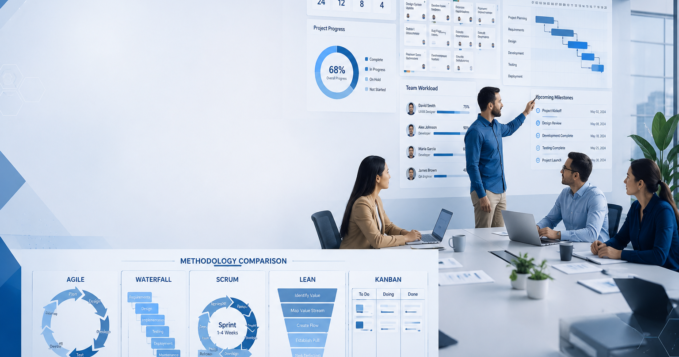
Choosing the right project management methodology can decide whether your project moves smoothly or struggles from the start. Many teams begin with excitement, but without the right structure, confusion quickly takes over. Deadlines slip, communication breaks down, and priorities become unclear.
That is why project management methodologies matter so much. They give teams a clear path to follow. They help define responsibilities, improve planning, reduce risk, and keep everyone focused on the same goal.
In this guide, you will learn the most popular project management methodologies, how they work, where they fit best, and how to choose the right one for your projects.
If you are building a stronger PMO, you may also want to read our guide on PMO best practices.
What Are Project Management Methodologies
Project management methodologies are systems used to plan, manage, and complete projects. They provide a framework for how work is organized, tracked, and delivered.
Instead of handling every project in a random way, teams use a methodology to create consistency. This helps managers make better decisions and helps team members understand what is expected of them.
A good methodology supports better communication, stronger accountability, and more predictable results. It also helps stakeholders understand project progress without needing constant updates.
According to the Project Management Institute, organizations with mature project management practices often achieve better project outcomes than those without a clear framework.
Why Choosing the Right Methodology Matters
Not every project works the same way. A software development team may need frequent changes and fast testing. A construction project may need detailed planning before work begins. A marketing team may need flexibility while launching campaigns.
Using the wrong methodology can create unnecessary problems. Teams may become too rigid when they need flexibility, or too loose when they need control.
Choosing the right methodology helps you:
Improve project planning
When your team follows a clear system, planning becomes easier. Everyone knows the stages, deadlines, and expected outcomes.
Reduce project risks
A good methodology helps teams identify problems early. This gives you more time to fix issues before they become expensive.
Strengthen communication
Methodologies improve coordination between teams, managers, and stakeholders. Clear workflows reduce misunderstandings.
Increase delivery success
Projects are more likely to finish on time and within budget when the management approach fits the work.
If you want to improve team alignment, you can also explore our article on project governance strategies.
Waterfall Methodology
Waterfall is one of the most traditional project management methodologies. It follows a step by step structure where one phase must be completed before the next phase begins.
This method usually includes planning, design, development, testing, and delivery.
When Waterfall works best
Waterfall is best for projects with clear requirements from the beginning. It works well when changes are unlikely and when teams need detailed documentation.
Examples include construction, manufacturing, compliance projects, and large infrastructure work.
Benefits of Waterfall
Waterfall is easy to understand. It creates a clear path from start to finish. It also works well for teams that need strict planning and approval processes.
Limitations of Waterfall
Waterfall is not ideal for projects that change often. If the team discovers a major issue late in the process, going back can be costly and time consuming.
Agile Methodology
Agile is one of the most widely used project management methodologies today. It focuses on flexibility, teamwork, and continuous improvement.
Instead of waiting until the very end to deliver results, Agile teams work in small cycles. They release smaller pieces of work, review progress regularly, and adjust based on feedback.
When Agile works best
Agile works best for projects where requirements may change. It is especially useful in software development, digital products, and fast moving business environments.
Benefits of Agile
Agile encourages collaboration, faster feedback, and early problem solving. Teams can adapt quickly when priorities change.
Limitations of Agile
Agile requires strong communication and active stakeholder involvement. Without that, the process can become messy and lose direction.
To understand this better, you can read more from the Agile Alliance.
Scrum Framework
Scrum is a popular framework that follows Agile principles. It organizes work into short periods called sprints. Each sprint usually lasts two to four weeks.
A Scrum team often includes a Product Owner, a Scrum Master, and a delivery team. Together, they plan work, review progress, and improve after each sprint.
When Scrum works best
Scrum works well for product teams, software teams, and groups that need regular progress reviews.
Benefits of Scrum
Scrum creates accountability, improves visibility, and supports fast delivery. Teams can quickly spot blockers and fix them.
Limitations of Scrum
Scrum needs discipline. If the team ignores sprint planning, reviews, or clear roles, the process may fail.
If your site has a related post later, add an internal link here to your Scrum article.
Lean Methodology
Lean focuses on delivering value while removing waste. It started in manufacturing but is now used in project management, operations, and service teams.
The main idea is simple. Keep what adds value and remove what does not.
When Lean works best
Lean works well in process improvement, operations, and environments where efficiency matters.
Benefits of Lean
Lean can reduce costs, improve speed, and help teams focus on meaningful work.
Limitations of Lean
Lean requires a culture of continuous improvement. Without team support, it can be hard to maintain.
Kanban Methodology
Kanban is a visual way to manage work. Teams use boards with columns such as To Do, In Progress, and Done to track tasks.
Kanban helps teams see bottlenecks, manage workloads, and improve flow.
When Kanban works best
Kanban works well for support teams, content teams, service teams, and any group that handles ongoing work.
Benefits of Kanban
It is easy to use, easy to understand, and helps teams improve workflow without major disruption.
Limitations of Kanban
Kanban may not provide enough structure for complex projects with strict deadlines unless it is combined with another method.
How to Choose the Right Project Management Methodology
Choosing the best project management methodology depends on your project type, team structure, and business goals.
Here are a few smart questions to ask before deciding.
Are the requirements clear from the beginning
If yes, Waterfall may be a strong choice.
Will the project change often
If yes, Agile or Scrum may be better.
Is efficiency the main goal
If yes, Lean could be useful.
Does your team manage continuous work
If yes, Kanban may be the right fit.
Does your team need a highly structured process
If yes, Waterfall or Scrum may work better than a loose framework.
The best choice is not always the most popular one. It is the one that fits your real working environment.
Common Mistakes Teams Make
Many organizations choose a methodology because it sounds modern, not because it fits their project. This creates unnecessary frustration.
Some of the most common mistakes include:
Choosing Agile without team training
Using Waterfall for projects that change every week
Applying Scrum without clear sprint discipline
Trying to copy another company without understanding internal needs
Ignoring stakeholder involvement during methodology changes
A successful project methodology should support the team, not make work harder.
Final Thoughts
The best project management methodologies give teams structure, clarity, and confidence. They help people work better together and improve the chances of project success.
Waterfall offers control and clear stages. Agile offers flexibility and fast feedback. Scrum adds strong team rhythm. Lean improves efficiency. Kanban makes work visible and manageable.
There is no single perfect approach for every team. The smartest choice is the one that matches your project needs, your team culture, and your business goals.
When you choose carefully, your methodology becomes more than a process. It becomes a real advantage.
Frequently Asked Questions
What are project management methodologies
Project management methodologies are structured approaches used to plan, organize, and deliver projects. They help teams manage work in a consistent and effective way.
Which project management methodology is best
The best methodology depends on the project. Agile is great for flexible work, Waterfall is ideal for fixed requirements, Scrum works well for sprint based delivery, and Lean is useful for improving efficiency.
What is the difference between Agile and Waterfall
Agile is flexible and allows ongoing changes during the project. Waterfall follows a fixed sequence where each phase is completed before the next begins.
Is Scrum the same as Agile
Scrum is not the same as Agile, but it is based on Agile principles. Scrum is a specific framework used to manage work in short cycles.
Can one company use more than one methodology
Yes, many companies use different methodologies for different teams or projects. Some even use hybrid models depending on business needs.