
Every project comes with uncertainty. No matter how experienced the team is or how detailed the plan looks on paper, unexpected issues can still appear and disrupt progress. That's why project risk assessment is such an important part of successful project management.
A good risk assessment process helps teams identify possible threats early, understand their impact, and take action before small issues turn into major problems. Instead of reacting at the last minute, project managers can make better decisions, protect resources, and improve the chances of project success.
In this comprehensive guide, we'll explore what project risk assessment means, why it matters, and how to identify and mitigate risks in a practical, proven way.
What Is Project Risk Assessment?
Project risk assessment is the systematic process of identifying, analyzing, and evaluating potential risks that may affect a project's objectives, timeline, cost, quality, or scope. It's a fundamental practice in modern project management.
These risks may come from internal challenges, such as poor planning or limited resources, or external issues, such as regulatory changes, vendor delays, or market uncertainty.
The purpose of project risk assessment is not to remove all risk entirely. That's rarely possible. Instead, the goal is to understand what could go wrong, estimate how serious it could be, and prepare a realistic response plan.
When integrated with a solid project planning strategy, project risk assessment becomes a core part of how successful teams manage uncertainty and protect project objectives.
Why Project Risk Assessment Matters
Many projects fail not because the goals were unrealistic, but because teams did not prepare for things that could go wrong. Project risk assessment creates a proactive mindset. It helps project managers think ahead rather than scramble under pressure.
Key Benefits of Project Risk Assessment
- Improves planning and decision-making
- Reduces delays and budget overruns
- Helps allocate resources more effectively
- Builds confidence among stakeholders
- Supports better communication across the team
- Increases the overall likelihood of project success
- Protects profitability and reputation
When risks are managed early through proper project risk assessment, teams are usually more stable, more focused, and less likely to be caught off guard. This is similar to how proper project scope management prevents uncontrolled changes during execution.
Common Types of Project Risks You Need to Know
Not all project risks are the same. Some affect time, others affect cost, quality, or stakeholder trust. Understanding the main categories of project risk assessment makes the assessment process more practical and actionable.
Schedule Risks and Timeline Issues
These risks affect deadlines and project timelines. They often happen when tasks take longer than expected, approvals are delayed, or dependencies are not properly managed. Schedule risks are among the most common project risk assessment challenges.
Common causes include:
- Unrealistic time estimates
- Resource unavailability
- Approval delays
- Unexpected technical complications
- Team member absence or turnover
Cost Risks and Budget Overruns
Cost risks involve budget increases caused by poor estimates, scope changes, inflation, rework, or unexpected expenses. Accurate project risk assessment helps prevent cost escalation.
Examples of cost risks include:
- Supplier price increases
- Currency fluctuations
- Scope creep without budget adjustment
- Rework due to quality issues
- Hidden costs discovered mid-project
Resource Risks and Team Challenges
These risks happen when the team lacks the people, tools, equipment, or skills needed to complete the work efficiently. A robust resource management plan combined with proper project risk assessment can significantly reduce these issues.
Resource risk factors:
- Key person dependencies
- Skills gaps in the team
- Equipment shortages
- Vendor unavailability
- Contractor availability
Technical Risks and System Failures
Technical risks involve software failures, integration issues, unclear requirements, system limitations, or engineering challenges. Technical project risk assessment is critical in technology-driven projects.
Technical risk examples:
- New technology adoption
- Legacy system integration
- Third-party API reliability
- Data migration issues
- Cybersecurity vulnerabilities
Scope Risks and Requirement Changes
Scope risks occur when project requirements change too often or are not clearly defined from the beginning. This often leads to confusion, delays, and rework. Project risk assessment helps identify scope creep early.
Scope risk scenarios:
- Undefined or changing requirements
- Client expectation misalignment
- Feature creep
- Unclear success criteria
- Stakeholder disagreement
External Risks Beyond Your Control
These come from outside the project team. Common examples include legal changes, vendor issues, market shifts, natural events, and political or economic uncertainty. Understanding external risk factors through project risk assessment aligns with established risk management frameworks.
External risk types:
- Regulatory changes
- Market disruptions
- Natural disasters
- Vendor bankruptcy
- Economic downturns
- Political instability
How to Conduct an Effective Project Risk Assessment: 5-Step Process
A structured process makes project risk assessment far more useful. Instead of treating risk as a vague concern, teams can break it down into clear steps and manage it properly throughout the project lifecycle.
Step 1: Identify Potential Risks for Project Risk Assessment
Start by listing anything that could affect the project. Talk to team members, stakeholders, vendors, and subject matter experts. Review lessons learned from previous projects and consider both internal and external threats when conducting project risk assessment.
How to Identify Risks
The identification phase is critical. Use multiple methods to ensure comprehensive coverage:
Brainstorming Sessions
Gather the project team and stakeholders to discuss potential threats. Document all ideas without judgment during brainstorming.
Risk Workshops
Conduct focused sessions with specific departments or experts. Have them identify risks in their areas of responsibility.
SWOT Analysis
Review Strengths, Weaknesses, Opportunities, and Threats. Threats section maps directly to project risks.
Expert Interviews
Talk to people with experience in similar projects. Their insights reveal common pitfalls.
Historical Review
Examine lessons learned from completed projects. Past problems often repeat if not addressed.
Risk Checklists
Use industry-standard checklists to ensure no obvious risks are missed during project risk assessment.
Following Project Management Institute standards can provide structured frameworks for this critical phase of project risk assessment.
Step 2: Analyze the Identified Risks in Detail
Once risks are identified through project risk assessment, the next step is to assess how likely each one is and how much damage it could cause to project objectives.
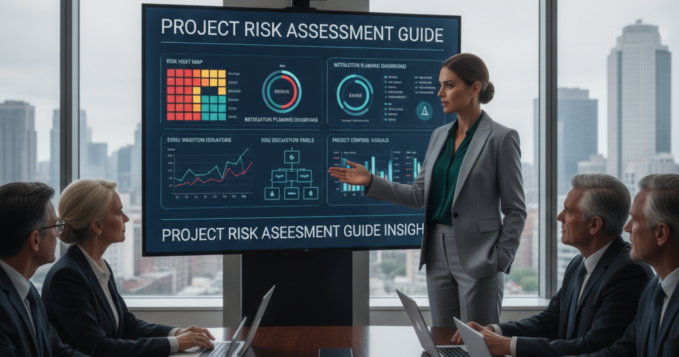
A risk that is very likely and highly damaging should receive more attention than one that is rare but minor. Many teams use a simple risk matrix to classify risks as low, medium, or high during project risk assessment.
Risk Analysis Questions
Ask these questions during project risk assessment analysis:
Likelihood Assessment
- How likely is this risk to occur? (0-100%)
- What factors increase or decrease the probability?
- Has this happened on similar projects?
Impact Assessment
- What would be the impact if it happens?
- How many project objectives would be affected?
- What is the financial impact?
- How would it affect the timeline?
Stakeholder Impact
- Which departments or stakeholders would be affected?
- How would they be impacted?
- What escalation might occur?
Recovery Assessment
- How long would recovery take?
- What resources would be needed for recovery?
- What is the cost of recovery?
Step 3: Prioritize the Most Important Risks
Not every risk needs the same level of response. Prioritization helps the team focus on the risks that matter most in project risk assessment.
A practical approach is to rank risks based on:
Priority Ranking Factors
Likelihood of Occurrence
What is the probability this risk will happen? Higher probability = higher priority.
Impact on Project Objectives
How severely would this risk damage project goals? Greater impact = higher priority.
Urgency of Response Needed
How soon must we respond if this risk appears? More urgent = higher priority.
Ease of Mitigation
How difficult is it to reduce or prevent this risk? Easier mitigation = handle early.
This helps project managers use time and resources wisely during project risk assessment execution.
Step 4: Develop Mitigation Strategies for Each Risk
After prioritizing the risks through project risk assessment, develop a response plan for each important one. This is where project risk assessment becomes actionable and prevents problems.
The Four Risk Response Strategies
Avoid the Risk
Change the project plan to remove the risk entirely. This is the most protective approach but may not always be possible.
Examples of risk avoidance:
- Choose a proven technology instead of experimental one
- Use established vendors instead of untested suppliers
- Assign experienced staff to critical tasks
- Simplify project scope to reduce complexity
Reduce the Risk
Take steps to lower the chance of the risk happening or reduce its impact. This is the most common project risk assessment strategy.
Examples of risk reduction:
- Conduct thorough testing to catch technical issues early
- Hire specialists to reduce skill gaps
- Use project management tools for better tracking
- Implement quality assurance processes
- Create redundancy in critical functions
Transfer the Risk
Shift the risk to another party, such as through insurance, outsourcing, or contractual agreements. This moves responsibility but may add costs.
Examples of risk transfer:
- Purchase insurance against equipment failure
- Outsource technical work to specialized vendors
- Use fixed-price contracts to transfer cost risks
- Engage subcontractors for specialty work
- Use service level agreements (SLAs) with vendors
Accept the Risk
Acknowledge the risk and prepare a contingency plan if it occurs. This approach works for low-impact risks or when mitigation isn't feasible.
Examples of risk acceptance:
- Create contingency budgets for cost overruns
- Maintain backup resources
- Develop alternative plans for critical activities
- Build schedule buffer time
- Establish escalation procedures
Step 5: Monitor and Review Risks Regularly
Risk assessment is not a one-time exercise. New risks may appear as the project moves forward, and existing risks may become more serious or less relevant. Ongoing project risk assessment is essential.
Continuous Risk Monitoring
Weekly Reviews
During status meetings, review active risks and their status changes.
Milestone Reviews
At each project milestone, reassess risks and identify new ones.
When Changes Occur
Any major project change should trigger risk reassessment.
Stakeholder Feedback
Listen to stakeholder concerns about emerging risks.
Team Observations
Encourage team members to flag new risks immediately.
Maintain a living risk register document that includes risk ID, description, likelihood, impact, priority, owner, mitigation strategy, and status.
Best Practices for Effective Project Risk Assessment
Some teams complete a risk checklist once and never look at it again. That approach rarely works. Effective project risk assessment requires consistency and communication, in line with ISO 31000 risk management standards.
Start Early with Project Risk Assessment
Project risk assessment should begin during project planning, not after the project starts falling behind. Early identification prevents costly reactive measures.
Why Early Assessment Matters:
- More time to develop mitigation strategies
- Lower cost to implement preventive actions
- Better stakeholder awareness
- Stronger project planning
- Reduced emergency decisions
Start risk assessment in the planning phase before team assignment.
Keep a Living Risk Register
A risk register helps document each risk identified in project risk assessment, including its impact, owner, mitigation plan, and current status. Update it weekly.
What to Include in Risk Register:
- Risk description
- Category classification
- Likelihood and impact ratings
- Priority score
- Mitigation strategy
- Responsible owner
- Status and progress
- Review dates
Make the risk register accessible to the entire team.
Assign Clear Ownership for Each Risk
Every major risk identified in project risk assessment should have someone responsible for tracking and responding to it. Clear accountability improves action.
Ownership Responsibilities:
- Monitor the risk indicator
- Track mitigation progress
- Report status regularly
- Escalate if situation changes
- Implement contingency if risk occurs
- Update risk register
Owners should have authority to take action and access to resources needed for mitigation.
Communicate Project Risk Assessment Findings Clearly
If risks are hidden or poorly explained, they become harder to manage. Stakeholders need timely and honest updates about project risk assessment results.
Communication Best Practices:
- Share risk findings transparently
- Explain impact in business terms
- Present realistic mitigation options
- Update regularly on status
- Escalate critical risks immediately
- Encourage team questions
Use visual formats like risk matrices and trend charts to make findings clear.
Review Lessons Learned After Project Risk Assessment
Past projects often reveal patterns. Reviewing what went wrong before helps prevent repeated mistakes in current project risk assessment efforts.
Lessons Learned Process:
- Document what went wrong
- Analyze root causes
- Identify early warning signs
- Record mitigation approaches
- Share with future projects
- Update risk checklists
Create a company risk knowledge base from lessons learned.
Balance Caution with Forward Progress
Overanalyzing every possible problem in project risk assessment can slow a project down. The goal is to be prepared, not paralyzed by analysis.
Finding the Balance:
- Focus assessment on significant risks
- Use time-bound analysis sessions
- Make decisions based on best available information
- Move forward with mitigation plans
- Adjust as new information emerges
- Trust your analysis
Remember that perfect certainty is impossible.
Common Mistakes to Avoid in Project Risk Assessment
Even when teams understand the value of project risk assessment, they can still make avoidable mistakes that undermine their efforts.
Ignoring Low-Probability, High-Impact Risks
Some risks seem unlikely, but if they happen, the consequences are severe. These should not be dismissed during project risk assessment, even if probability is low.
Examples:
- Natural disasters (low probability, catastrophic impact)
- Key person departure (low probability, severe impact)
- Cyber attacks (increasing probability, severe impact)
- Market disruption (may seem unlikely, devastating impact)
Reserve resources for low-probability, high-impact risks.
Treating Project Risk Assessment as a One-Time Task
Projects change, and risks change with them. A static risk plan quickly becomes outdated. Project risk assessment must be continuous.
Why Continuous Assessment Matters:
- New risks emerge as work progresses
- Mitigation success changes risk levels
- External factors change probability
- Team changes affect resource risks
- Technical discoveries alter risk picture
Schedule regular risk review meetings throughout the project.
Failing to Involve the Right People in Project Risk Assessment
Project managers should not assess risk alone. Team members often see operational risks that leadership may overlook during project risk assessment.
Who Should Participate:
- Project manager
- Project sponsor
- Team leads
- Technical experts
- Key stakeholders
- Experienced team members
- Process specialists
Include diverse perspectives to catch risks from all angles.
Having No Contingency Plan
Identifying a risk without preparing a response leaves the team vulnerable when the issue occurs. Every risk in project risk assessment needs an action plan.
Contingency Planning:
- Develop specific response steps
- Identify required resources
- Establish escalation triggers
- Assign backup resources
- Test contingency plans when possible
- Keep plans updated
Be ready to act immediately if a risk materializes.
Not Allocating Budget for Risk Response
Project risk assessment findings are useless without funding to implement mitigation strategies. Budget contingency reserves accordingly.
Budget Allocation:
- Reserve percentage of project budget (typically 10-20%)
- Allocate specific mitigation costs
- Fund prevention activities
- Support contingency planning
- Enable rapid response
Get budget approval for risk response activities during planning.
Real-World Project Risk Assessment Example
Consider a software development project. Project risk assessment might identify several critical threats requiring mitigation strategies.
Scenario: SaaS Platform Development Project
Risk 1: Schedule Risk
Situation: Team members unfamiliar with the new technology framework
Assessment: 70% probability, high impact on timeline
Mitigation: Hire contractor expert to train team early (cost: $15,000, timeline benefit: 3 weeks)
Risk 2: Cost Risk
Situation: Third-party API pricing increases mid-project
Assessment: 40% probability, medium impact on budget
Mitigation: Lock in pricing early or develop alternative API (cost: $8,000)
Risk 3: Technical Risk
Situation: Integration with legacy systems proves more complex
Assessment: 50% probability, high impact
Mitigation: Conduct integration assessment before main development (cost: $5,000)
Risk 4: Resource Risk
Situation: Key developer leaves the team mid-project
Assessment: 30% probability, severe impact
Mitigation: Cross-train backup developer, maintain knowledge documentation (cost: $10,000)
Risk 5: Scope Risk
Situation: Client adds new features without scope adjustment
Assessment: 60% probability, medium impact
Mitigation: Establish strict change control process, have change request procedure (cost: minimal)
Result
Through proper project risk assessment, this team would:
- Invest $38,000 in mitigation upfront
- Reduce probability of schedule overrun from 70% to 20%
- Reduce probability of cost overrun from 40% to 10%
- Increase team productivity through training
- Deliver project on time and on budget
The mitigation investment typically saves 3-5x the cost in avoided overruns.
Conclusion
Project risk assessment is one of the most practical tools in project management. It helps teams anticipate uncertainty, prepare smarter responses, and protect project goals before problems get out of control.
No project can eliminate risk completely, but every project can manage risk better through systematic project risk assessment. When teams identify potential threats early, analyze them properly, and respond with clear mitigation strategies, they improve both project performance and stakeholder confidence.
If you want stronger project outcomes, better decisions, and fewer surprises, project risk assessment should be part of your process from day one. Combine this with solid change management practices for maximum effectiveness.
Start your next project with a comprehensive project risk assessment framework, and watch how much smoother execution becomes. The investment in planning pays dividends throughout the project.
Frequently Asked Questions About Project Risk Assessment
What is project risk assessment?
Project risk assessment is the systematic process of identifying, analyzing, and evaluating risks that may affect a project's timeline, budget, scope, quality, or success. It's an essential practice for modern project management teams.
The goal is to understand what could go wrong, estimate the likelihood and impact, and prepare response strategies before problems occur. Learn more about strategic project planning to integrate risk assessment into your overall approach.
Why is project risk assessment important?
Project risk assessment helps project teams identify possible threats early, reduce uncertainty, improve planning, and create strategies to minimize negative impacts before they become costly problems that derail projects.
Studies show that projects with formal risk assessment are 30% more likely to succeed on time and on budget. Proper scope management combined with risk assessment creates a powerful advantage.
What are the main types of project risks?
Common project risk assessment categories include:
- Schedule risks (timeline delays)
- Cost risks (budget overruns)
- Technical risks (system failures)
- Scope risks (requirement changes)
- Resource risks (team gaps)
- External risks (market, regulatory, natural)
Each requires different mitigation strategies, as explored in resource management practices.
How do you mitigate project risks?
Project risks can be mitigated through four main strategies identified in project risk assessment:
Avoid: Change the plan to eliminate the risk
Reduce: Lower the probability or impact
Transfer: Shift the risk to another party
Accept: Prepare contingency plans for low-impact risks
Understanding these strategies is essential to effective change management during execution.
When should project risk assessment be performed?
Project risk assessment should begin during project planning and continue throughout the entire project lifecycle with regular reviews and updates at each milestone.
The earlier you assess risks, the more options you have to prevent or mitigate them. This aligns with best practices in project planning and execution.
What is a risk register?
A risk register is a documented list of all identified risks discovered through project risk assessment, including their likelihood, impact, mitigation strategies, owners, and status. It serves as a living document.
The risk register should be reviewed weekly and shared with stakeholders to keep everyone informed about project risk assessment status.
How often should risks be reviewed?
Risks should be reviewed regularly during project status meetings, milestone reviews, and whenever significant project changes occur that might affect project risk assessment findings.
Most projects benefit from weekly risk updates during execution phase. Integrate these reviews with your resource management and scope management processes.
Who should be involved in project risk assessment?
Project managers, team leads, stakeholders, subject matter experts, and team members should all participate in project risk assessment to ensure comprehensive risk identification.
Diverse perspectives catch risks that single experts might miss. Include representation from change management and technical teams.
What is the difference between risk and issue?
A risk is a potential threat that hasn't happened yet but may affect the project. An issue is a risk that has already occurred and now needs immediate resolution.
Both need to be managed, but risks are preventive while issues are reactive. Proper planning helps catch risks before they become issues.
How does project risk assessment improve outcomes?
Project risk assessment improves outcomes by enabling proactive planning, better resource allocation, reduced surprises, improved stakeholder confidence, and faster response times when issues occur.
Projects using formal risk assessment typically deliver 15-25% faster with 10-20% lower costs, especially when combined with strong resource management.
What is a contingency plan in project risk assessment?
A contingency plan is a prepared response strategy activated if a specific risk occurs. It includes the steps to take, resources needed, and timeline for implementation.
Having contingency plans ready allows faster response when risks materialize. Ensure all contingency plans are documented in your project plan.
How do you calculate risk priority in project risk assessment?
Risk priority is typically calculated by multiplying likelihood (1-5 scale) by impact (1-5 scale):
Risk Priority = Likelihood × Impact
Risks scoring 15-25 = Critical
Risks scoring 10-14 = High
Risks scoring 5-9 = Medium
Risks scoring 1-4 = Low
Use this scoring system consistently throughout project risk assessment for all projects.