
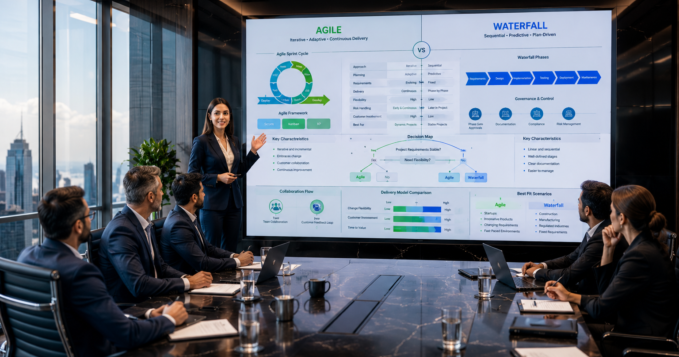
Agile vs waterfall project management methodology is one of the most common comparisons in project delivery because teams often need to decide how work should be planned, managed, reviewed, and delivered. The choice matters. A methodology influences how requirements are defined, how stakeholders are involved, how quickly teams can respond to change, and how progress is measured. When the method fits the project well, delivery tends to feel more stable and efficient. When the fit is poor, teams often struggle with avoidable friction, weak visibility, delayed decisions, or mismatched expectations.
Many organizations oversimplify the debate by treating agile and waterfall as opposites where one is modern and the other is outdated. In reality, both approaches can be effective when used in the right context. Waterfall can work well in projects where scope is stable, requirements are clear, and approvals must follow a structured sequence. Agile can be highly effective where change is expected, user feedback is important, and iterative delivery creates value. The real question is not which methodology is universally better. It is which one is better for your project environment, stakeholder needs, risk profile, and delivery goals.
That is why understanding agile vs waterfall project management methodology is so useful. It helps leaders move beyond trends and make more practical decisions about planning, governance, delivery pace, and team collaboration. In many real-world environments, the best answer is not purely one or the other, but a thoughtful balance based on project realities.
If your team is also improving how delivery models connect to governance, our project governance models guide can help strengthen oversight across different delivery approaches.
What Is Agile Project Management
Agile is a project and product delivery approach built around iterative progress, ongoing feedback, flexibility, and incremental value delivery. Instead of trying to define everything up front and deliver once at the end, agile teams typically work in shorter cycles and adapt based on learning.
Agile usually involves:
- iterative delivery
- continuous stakeholder feedback
- flexible prioritization
- cross-functional team collaboration
- regular review and adjustment
- focus on incremental value
Agile is often used in environments where requirements may evolve or where early feedback improves the final result.
What Is Waterfall Project Management
Waterfall is a more sequential project management methodology where work moves through defined stages such as requirements, design, build, testing, and implementation. Each phase is usually completed before the next begins.
Waterfall usually involves:
- detailed upfront planning
- fixed scope and sequencing
- stage-based governance
- formal documentation
- milestone-driven progress
- stronger change control
Waterfall is often effective when the project requires predictability, clear approvals, and limited requirement change.
Why the Agile vs Waterfall Project Management Methodology Choice Matters
The choice between agile and waterfall affects how teams work day to day and how leaders manage expectations. It shapes planning effort, governance style, reporting, stakeholder involvement, and how easily the project can respond to change.
Without careful thinking about agile vs waterfall project management methodology, organizations may experience:
- poor methodology fit
- confused stakeholder expectations
- weak control over scope or change
- misaligned governance
- slow response to risk
- delivery inefficiency
- reporting problems
- reduced team effectiveness
By contrast, the right methodology choice helps teams work in a way that supports the project rather than fighting it.
1. Waterfall Works Best When Requirements Are Stable
One of the clearest advantages of waterfall is that it performs well when the project scope is well understood from the beginning.
Waterfall is often suitable when
- requirements are unlikely to change
- design can be defined early
- compliance steps are mandatory
- approval gates must be followed
- downstream work depends on completed upstream work
Why this matters
Stable requirements reduce the risk of costly redesign in a sequential model.
2. Agile Works Better When Change Is Expected
Agile is strong when projects need to adapt as learning happens. This is one of the central differences in agile vs waterfall project management methodology.
Agile is often suitable when
- user needs will evolve
- innovation is important
- feedback should shape the product
- priorities may shift during delivery
- value can be delivered incrementally
Why this matters
Agile allows teams to refine direction without waiting until the end of the project.
3. Waterfall Offers Stronger Predictability Up Front
Many organizations prefer waterfall because it offers a clearer full-project plan at the beginning.
Waterfall planning usually gives visibility into
- full scope
- major milestones
- stage approvals
- estimated budget
- end-to-end timeline
Why this matters
This predictability is useful when leadership needs a structured delivery roadmap early.
4. Agile Improves Responsiveness and Learning
Agile allows teams to learn while delivering. Instead of assuming everything is known at the start, teams can test, review, and improve in shorter cycles.
Agile learning is supported through
- sprint reviews
- backlog reprioritization
- user feedback
- rapid iteration
- regular retrospectives
Why this matters
Projects benefit when learning is built into the delivery model rather than delayed until closure.
For broader perspective on iterative work and team effectiveness, the Atlassian agile project management resource offers useful practical guidance.
5. Stakeholder Engagement Looks Different in Each Model
Stakeholder involvement is not the same across agile and waterfall.
In waterfall, stakeholders often engage through
- requirements approval
- design reviews
- governance checkpoints
- milestone sign-off
In agile, stakeholders often engage through
- sprint reviews
- backlog conversations
- product feedback
- iterative prioritization
Why this matters
The methodology should match how available and involved stakeholders can realistically be.
6. Documentation Needs Are Usually Heavier in Waterfall
Waterfall generally relies more on formal documentation, especially where control, compliance, traceability, or contractual clarity are important.
Waterfall often emphasizes
- detailed requirements documents
- stage approval records
- formal change requests
- test plans and sign-offs
- structured governance documentation
Why this matters
Projects in regulated or audit-heavy environments may benefit from this structure.
7. Agile Requires Strong Team Collaboration and Maturity
Agile can deliver great results, but it also requires discipline. Teams need communication strength, fast feedback loops, and a willingness to work collaboratively.
Agile works best when teams can
- collaborate closely
- self-organize effectively
- respond quickly to change
- engage stakeholders often
- make fast decisions
Why this matters
Without team maturity and engagement, agile can become chaotic instead of adaptive.
8. Waterfall Can Be Better for Fixed-Scope Contracts
When a project involves vendors, procurement constraints, or tightly defined contractual commitments, waterfall may sometimes be easier to manage.
This is especially true when
- the scope is contractually fixed
- deliverables are defined in advance
- payment milestones depend on stage completion
- formal acceptance criteria are required
Why this matters
A sequential model may align better with commercial and contractual control.
If your team is also improving supplier oversight, our project procurement management strategies guide can help connect methodology choice with vendor management.
9. Agile Can Improve Customer-Centered Delivery
Agile often performs well when customer or end-user feedback is central to project success.
Agile supports customer-centered delivery through
- earlier demonstrations
- frequent refinement
- evolving priorities
- faster learning from user response
Why this matters
The product or solution is more likely to reflect real user needs by the time it is delivered.
10. Hybrid Approaches Are Often the Most Realistic
In many organizations, the actual answer in the agile vs waterfall project management methodology debate is not purely one or the other. A hybrid approach may combine structured governance with iterative delivery practices.
Hybrid methods may include
- waterfall planning with agile execution
- agile teams within stage-gate governance
- fixed milestones with flexible delivery cycles
- formal approvals with iterative development
Why this matters
Hybrid methods often reflect the real complexity of enterprise delivery better than strict methodology purity.
For broader leadership thinking on adapting management approaches, the Harvard Business Review article on planning and forecasting offers relevant insight into why rigid assumptions can fail.
11. The Best Choice Depends on Project Context
There is no single correct answer to agile vs waterfall project management methodology. The right choice depends on the nature of the work.
Useful decision factors include
- requirement stability
- stakeholder availability
- regulatory needs
- delivery speed expectations
- technical uncertainty
- team maturity
- governance requirements
- vendor and contract constraints
Why this matters
Methodology should serve project reality, not ideology.
12. Methodology Choice Should Be Reviewed, Not Assumed
One of the biggest mistakes organizations make is assuming the same methodology fits every project. Delivery methods should be reviewed deliberately at the start and sometimes revisited as conditions change.
Review questions may include
- is scope stable or evolving
- how often is feedback needed
- what governance is required
- how much documentation is necessary
- what risks does the project face
- what level of adaptability is realistic
Why this matters
A deliberate choice usually produces better alignment than defaulting to habit.
If your organization is also improving broader delivery structure, our project delivery framework guide can help support stronger model selection and delivery consistency.
Agile vs Waterfall: A Simple Comparison
Here is a practical side-by-side view of agile vs waterfall project management methodology:
Agile
- iterative and flexible
- welcomes changing requirements
- frequent stakeholder feedback
- incremental delivery
- lighter documentation in many cases
- works well in uncertain or evolving environments
Waterfall
- sequential and structured
- prefers stable requirements
- milestone-based stakeholder involvement
- full delivery often comes later
- stronger documentation and control
- works well in predictable or regulated environments
Common Mistakes When Choosing a Methodology
Even experienced teams can make poor methodology choices.
Choosing agile because it sounds modern
A trend-based choice may not fit the project.
Choosing waterfall without checking change likelihood
A rigid model may struggle when requirements evolve.
Ignoring stakeholder availability
Agile needs regular engagement. Waterfall may suit lower-frequency involvement better.
Applying one method to every project
Different projects need different management approaches.
Confusing hybrid with lack of discipline
Hybrid works best when it is designed intentionally.
Agile vs Waterfall Project Management Methodology Checklist
Use this checklist to choose more confidently:
- assess requirement stability
- review stakeholder availability
- check governance and compliance needs
- consider team maturity and collaboration style
- evaluate how much change is likely
- examine contract and vendor constraints
- decide whether incremental delivery adds value
- review documentation expectations
- consider whether a hybrid model fits better
- choose the method based on project reality
This checklist helps make agile vs waterfall project management methodology selection more practical and defensible.
Final Thoughts
Agile vs waterfall project management methodology is not a debate that should be decided by fashion or habit. Both approaches can work well when matched to the right context. Waterfall offers structure, predictability, and strong control. Agile offers adaptability, faster learning, and closer feedback loops. In many enterprise settings, hybrid models provide the most practical balance.
The smartest methodology decision is the one that supports the real needs of the project, the team, and the organization. When leaders choose deliberately, they create better conditions for collaboration, governance, responsiveness, and successful delivery.
Frequently Asked Questions
What is the difference between agile and waterfall project management
Agile is iterative and flexible, while waterfall is sequential and structured. Agile supports changing requirements more easily, while waterfall works well when requirements are stable.
Which is better, agile or waterfall
Neither is universally better. The right choice depends on project scope stability, stakeholder involvement, governance needs, team maturity, and delivery context.
When should a project use waterfall
Waterfall is often better when scope is clear, approvals are structured, documentation is important, and changes are expected to be limited.
When should a project use agile
Agile is often better when feedback is needed frequently, requirements may evolve, and value can be delivered in increments.
Is hybrid better than agile or waterfall
Hybrid is often useful when organizations need both governance structure and delivery flexibility. It can be better when designed intentionally for the project context.