
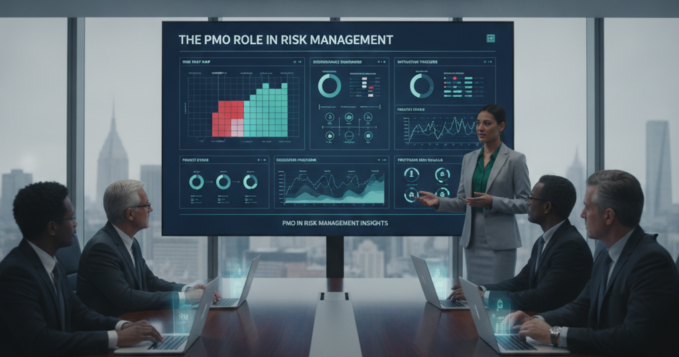
The role of the PMO in risk management is essential because projects rarely fail only because of one obvious issue. More often, project failure happens when risks are not identified early, ownership is unclear, warning signs are ignored, or teams do not have a structured way to respond. In these situations, the Project Management Office becomes a critical part of organizational control. A strong PMO helps projects move beyond informal risk discussions and toward a disciplined approach that improves visibility, accountability, and decision-making across the portfolio.
In many organizations, project teams are focused heavily on delivery deadlines, stakeholder requests, budget management, and day-to-day execution. While those demands are important, they can also push risk thinking into the background. Teams may record a few risks at the start of a project and then fail to review them properly as the work evolves. Others may notice emerging threats but not escalate them early enough. This is where the PMO adds real value. It creates structure, standards, reporting, escalation paths, and governance routines that make risk management more practical and more consistent across multiple projects.
A mature PMO does not remove risk from projects. That is impossible. Instead, it improves how the organization understands risk, responds to it, and makes decisions in uncertain conditions. It helps project managers identify threats more clearly, evaluate probability and impact more consistently, assign owners, monitor mitigation actions, and report material concerns to leadership. At the portfolio level, it also helps the business spot recurring patterns, shared dependencies, capacity pressures, vendor risks, and governance gaps that individual projects may not see on their own.
This becomes especially important in complex delivery environments. Large programs, transformation initiatives, technology changes, regulatory projects, and cross-functional portfolios all involve moving parts that can create uncertainty. Risks may come from scope changes, budget pressure, supplier underperformance, stakeholder conflict, resource shortages, technical issues, market shifts, or weak governance. Without PMO involvement, these risks are often managed inconsistently. With strong PMO support, they become more visible and easier to control.
The PMO also helps create a culture where risk management is not seen as a negative exercise or a bureaucratic checklist. Instead, it becomes part of good delivery discipline. Teams learn that raising risks early is a sign of professionalism, not failure. Sponsors receive clearer reporting. Leaders gain better escalation insight. Project managers get stronger tools and support. Over time, this improves organizational maturity and strengthens project outcomes.
If your organization is also improving governance and oversight, our project governance best practices guide can help strengthen decision-making and accountability across project environments.
Why the Role of the PMO in Risk Management Matters
Projects operate in uncertain environments. Even well-planned initiatives can face changing priorities, dependency failures, cost pressure, resource shortages, stakeholder resistance, technical issues, and delivery delays. Risk management matters because uncertainty is unavoidable, and unmanaged uncertainty quickly turns into project problems.
The role of the PMO in risk management matters because it helps organizations:
- create a consistent risk management process
- improve early identification of threats
- strengthen risk reporting and escalation
- align risk handling with governance routines
- improve accountability for mitigation actions
- identify portfolio-level patterns and shared risks
- support better decision-making under uncertainty
- increase confidence in delivery planning and control
Without PMO support, many organizations experience fragmented risk practices. One project may maintain a strong risk log, while another relies on informal conversations. One manager may escalate early, while another delays. A PMO helps reduce this inconsistency and build a common standard across projects. If your team is also improving structured visibility, our project reporting guide can help reinforce clearer updates and better leadership insight.
What the PMO Does in Risk Management
The PMO typically plays both a governance role and a practical support role. It may not own every project risk directly, but it often defines how risks should be managed and monitored.
Typical PMO risk management responsibilities include
- setting risk management standards
- maintaining templates and reporting formats
- supporting risk identification and assessment
- reviewing risk registers
- escalating major concerns
- monitoring mitigation progress
- identifying cross-project risks
- supporting leadership decisions with risk insight
This makes the PMO a key enabler of more disciplined and visible risk management.
1. Establishing a Consistent Risk Management Framework
One of the most important contributions of the PMO is establishing a common framework for how risks are identified, assessed, recorded, and reported. Without this, every project may define and manage risks differently.
A framework may include
- standard risk categories
- scoring methods for probability and impact
- templates for risk logs
- review frequency expectations
- escalation thresholds
- governance reporting requirements
Why this matters
Consistency improves comparability, clarity, and organizational control.
2. Supporting Early Risk Identification
A strong PMO encourages teams to identify risks early rather than waiting for problems to appear. This may happen during project initiation, planning, stage reviews, or regular delivery meetings.
Early risk identification may involve
- risk workshops
- planning reviews
- dependency analysis
- stakeholder analysis
- vendor risk discussions
- lessons learned from previous projects
Why this matters
Early identification gives teams more time to prepare and reduces the chance of avoidable disruption.
3. Improving Risk Assessment Quality
Not all projects assess risks well. Some teams overstate threats, while others underestimate serious issues. The PMO helps improve quality by introducing clearer assessment criteria and more disciplined review.
Risk assessment may look at
- likelihood of occurrence
- potential impact
- urgency
- detectability
- dependency effects
- financial or delivery consequences
Why this matters
Better assessment helps teams prioritize attention and resources more effectively.
4. Strengthening Risk Ownership and Accountability
A risk register is only useful if each important risk has a clear owner and practical mitigation actions. PMOs often help ensure that ownership is not vague or ignored.
Accountability may include
- named risk owners
- target dates for mitigation actions
- escalation responsibilities
- review cadence
- action follow-up in governance meetings
Why this matters
Clear accountability makes it more likely that risks will be managed actively rather than documented and forgotten.
For broader professional guidance on project risk management and delivery standards, the Project Management Institute offers useful resources on governance, risk control, and project management practices.
5. Monitoring Risk Trends Across Projects
One of the biggest advantages of PMO involvement is that it can see patterns across multiple projects. Individual project managers often focus only on their own initiative, but the PMO can identify repeated or shared threats.
Cross-project patterns may include
- recurring resource shortages
- common vendor performance issues
- repeated governance delays
- dependency conflicts
- similar stakeholder resistance
- repeated budget pressure
Why this matters
Portfolio-level visibility allows organizations to address root causes rather than only isolated symptoms.
6. Integrating Risk Management With Governance
Risk management works better when it is built into regular governance rather than treated as a separate exercise. PMOs often help bring risks into steering meetings, status reports, and escalation forums.
Governance integration may include
- risk reporting in project dashboards
- high-risk review in steering committees
- escalation thresholds for critical issues
- sponsor discussion of major exposures
- governance review of mitigation effectiveness
Why this matters
When leadership sees risk clearly, decisions can be made faster and with better context.
7. Improving Escalation of Material Risks
Some of the most damaging project failures happen not because risks were invisible, but because they were not escalated properly. PMOs can define escalation rules and make it easier for teams to raise serious concerns.
Escalation may be triggered by
- severe delivery risk
- material budget exposure
- unresolved dependency issues
- major supplier underperformance
- compliance concerns
- repeated mitigation failure
Why this matters
Timely escalation can prevent risks from growing into major delivery failures.
8. Supporting Better Decision-Making Under Uncertainty
Leaders often need to make decisions before every fact is known. The PMO supports this by providing structured risk information rather than vague concern statements.
Better decision support may include
- clear risk summaries
- impact scenarios
- mitigation progress visibility
- decision options with risk implications
- confidence levels around forecasts
Why this matters
Better information leads to better decisions and fewer surprises.
9. Encouraging a More Mature Risk Culture
The role of the PMO in risk management is not only procedural. It is also cultural. PMOs influence whether teams see risk management as useful or as paperwork.
A mature risk culture often includes
- open discussion of uncertainty
- early raising of concerns
- honest status reporting
- shared responsibility for mitigation
- learning from previous project issues
Why this matters
Culture affects whether risk practices are actually used well in real delivery conditions.
10. Improving Documentation and Lessons Learned
Strong risk management depends on good records. PMOs often help maintain consistent documentation and ensure lessons from previous projects are not lost.
Useful documentation may include
- risk registers
- mitigation action logs
- escalation records
- decision history
- lessons learned from realized risks
- trend reporting across projects
Why this matters
Documentation improves accountability and helps future projects avoid repeating the same mistakes.
11. Strengthening Organizational Resilience
The final way the PMO contributes is by strengthening the organization’s overall resilience. Projects will always face uncertainty, but resilient organizations respond faster and more effectively.
Resilience is supported by
- stronger governance
- earlier warning signals
- consistent processes
- better cross-project visibility
- faster escalation
- clearer leadership decisions
Why this matters
A resilient organization handles disruption better and improves long-term project success.
If your PMO is also strengthening external oversight, our contract management in PMO guide can help reinforce supplier control, commercial visibility, and risk reduction.
Common Risk Management Mistakes Without PMO Support
Even experienced teams can struggle when risk management lacks structure.
Treating risks as a one-time exercise
Risks change throughout the project and need active review.
Keeping ownership vague
Unnamed risks often go unmanaged.
Failing to escalate early
Late escalation reduces response options.
Reporting risks inconsistently
Leaders need comparable and meaningful visibility.
Ignoring cross-project patterns
Shared risks often require organizational action, not only project action.
Best Practices for Stronger PMO Risk Management
Organizations usually improve results when they apply a few disciplined habits.
Standardize the process
Use common templates, definitions, and scoring methods.
Review risks regularly
Risk logs should stay active and current.
Connect risks to governance
Important risks should be visible in leadership forums.
Encourage openness
Teams should feel safe raising concerns early.
Learn from outcomes
Use realized risks to improve future planning.
The Role of the PMO in Risk Management Checklist
Use this checklist to strengthen the role of the PMO in risk management:
- establish a consistent risk management framework
- support early risk identification
- improve risk assessment quality
- strengthen risk ownership and accountability
- monitor risk trends across projects
- integrate risk management with governance
- improve escalation of material risks
- support better decision-making under uncertainty
- encourage a mature risk culture
- improve documentation and lessons learned
- strengthen organizational resilience
This checklist helps make the role of the PMO in risk management more practical, visible, and effective across real project environments.
Final Thoughts
The role of the PMO in risk management is essential because uncertainty is part of every project, but unmanaged uncertainty is what causes avoidable damage. A strong PMO gives project teams and leaders the structure they need to identify, assess, monitor, escalate, and reduce risks more effectively. It improves consistency across projects, strengthens governance, and helps organizations respond earlier when warning signs appear.
The best PMOs do not treat risk management as a passive reporting requirement. They treat it as an active discipline that improves decision-making, accountability, and delivery confidence. When organizations strengthen the role of the PMO in risk management, they improve project control, reduce avoidable disruption, and increase the likelihood of successful outcomes.
Frequently Asked Questions
What is the role of the PMO in risk management
The role of the PMO in risk management is to establish standards, support identification and assessment, improve reporting, monitor trends, and strengthen governance and escalation across projects.
Why is the PMO important in risk management
The PMO is important because it creates consistency, improves visibility, and helps organizations manage project risks in a more structured and proactive way.
Does the PMO own project risks
Not always. Individual project managers and business owners may own specific risks, but the PMO often provides the framework, oversight, and governance support.
How does the PMO improve risk reporting
It improves risk reporting by using common templates, clearer scoring methods, regular review cycles, and governance integration.
Can PMO risk management improve project success
Yes. Better risk management helps teams identify threats earlier, respond more effectively, and avoid unnecessary delivery disruption.