
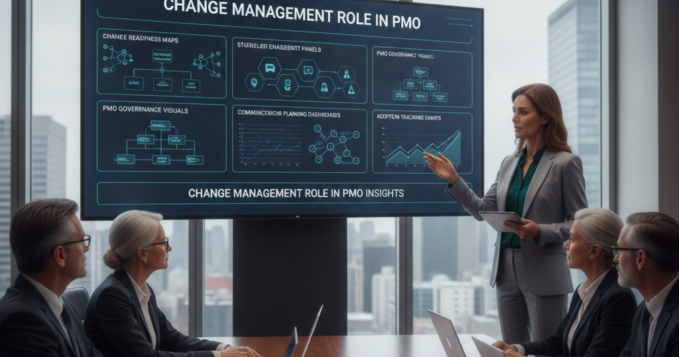
The change management role in PMO is increasingly important because projects do not succeed through planning and execution alone. Many initiatives fail not because the technical solution is poor, but because people are not ready, willing, or able to adopt the change. A project may deliver the intended system, process, or operating model, yet still fall short if stakeholders resist it, misunderstand it, or fail to embed it in daily work. This is where the PMO can play a valuable role by connecting project delivery with the people side of change.
Traditionally, some PMOs focused mainly on reporting, governance, templates, and delivery oversight. Those responsibilities still matter, but modern PMOs are often expected to support broader organizational outcomes. That includes helping projects manage stakeholder impact, communication planning, readiness, adoption, and transition into business-as-usual operations. In this context, the change management role in PMO becomes a practical way to improve not only delivery control but also implementation success.
A strong change management role in PMO helps organizations move beyond the idea that change management is separate from project management. In reality, the two are closely connected. Projects create change, and change needs to be managed deliberately. When the PMO helps embed that discipline, it becomes easier to align stakeholders, reduce resistance, improve communication, and increase the likelihood that project outcomes will be sustained after go-live.
If your organization is also strengthening PMO foundations, our PMO charter guide can help support clearer PMO purpose and accountability alongside change leadership.
Why the Change Management Role in PMO Matters
The change management role in PMO matters because delivery success depends on more than schedule, scope, and budget. Projects often create new processes, new tools, new responsibilities, or new ways of working. If people are not prepared for those shifts, project benefits can be delayed or lost.
Without a strong change management role in PMO, organizations often face:
- low stakeholder adoption
- weak communication planning
- resistance to change
- poor transition into operations
- reduced benefit realization
- confusion about new roles
- limited change readiness
- weaker long-term outcomes
By contrast, stronger change support improves implementation quality and business acceptance. If your team is also improving strategic alignment, our project alignment strategies guide can help connect change efforts with broader business priorities.
1. Connects Project Delivery With People Adoption
One of the most important aspects of the change management role in PMO is helping teams understand that successful delivery includes adoption, not only implementation.
This may involve
- identifying affected stakeholders
- mapping change impacts
- planning adoption activities
- supporting transition into new ways of working
Why this matters
Projects create value only when people actually use and sustain the intended change.
2. Improves Stakeholder Engagement
Strong stakeholder engagement is a core part of the change management role in PMO. The PMO can help ensure projects do not treat stakeholders as passive recipients of change.
Engagement may include
- stakeholder analysis
- targeted communication
- feedback channels
- sponsor involvement
- change network support
Why this matters
Engaged stakeholders are more likely to support change and less likely to resist it.
3. Strengthens Communication Planning
Communication is often one of the most visible parts of the change management role in PMO. The PMO can help projects move from generic updates to purposeful communication that supports understanding and readiness.
Communication planning may include
- change messaging
- audience segmentation
- timing of updates
- leadership communication
- feedback opportunities
Why this matters
People cope with change better when communication is timely, relevant, and clear.
4. Supports Change Readiness Assessment
One of the more valuable elements of the change management role in PMO is assessing whether teams and stakeholders are ready for implementation.
Readiness assessment may include
- awareness of the change
- understanding of impacts
- leadership support
- training needs
- local preparedness
- organizational capacity
Why this matters
Readiness gaps identified early are easier to address before deployment.
For broader professional guidance, the Project Management Institute provides useful resources on project delivery, stakeholder engagement, and organizational change.
5. Helps Manage Resistance to Change
Resistance is a normal part of change, not necessarily a sign of failure. A practical change management role in PMO helps teams identify and address resistance constructively.
Resistance management may involve
- understanding stakeholder concerns
- clarifying misconceptions
- improving sponsor visibility
- involving affected teams earlier
- adjusting support plans
Why this matters
When resistance is understood rather than ignored, adoption improves.
6. Improves Training and Support Planning
Training should not be left until the end of the project. The change management role in PMO often includes helping projects prepare users for new tools, processes, and responsibilities.
Training support may include
- training needs analysis
- user support materials
- role-based learning plans
- go-live support
- reinforcement activities
Why this matters
People adopt change more successfully when they feel capable, not just informed.
7. Supports Benefit Realization
A project can technically finish without delivering full benefit. One of the strongest contributions of the change management role in PMO is helping projects connect implementation with real organizational outcomes.
This may include
- adoption tracking
- usage monitoring
- benefit follow-up
- business readiness review
- post-implementation support
Why this matters
Benefits are more likely to materialize when change is actively embedded.
8. Strengthens Governance for Organizational Change
The change management role in PMO should not sit outside governance. Strong PMOs integrate change considerations into project oversight and decision making.
Governance support may include
- change impacts in status reporting
- readiness reviews
- escalation of adoption risks
- sponsor accountability
- implementation checkpoints
Why this matters
Governance improves when people-related risks are visible, not hidden behind delivery progress.
If your organization is also improving oversight, our project governance best practices guide can help strengthen governance structure alongside change management.
9. Helps Standardize Change Practices Across Projects
A PMO is well placed to create consistency in how change is managed across multiple initiatives. This is one of the most strategic parts of the change management role in PMO.
Standardization may include
- change templates
- stakeholder mapping methods
- readiness checklists
- communication standards
- training planning guidance
Why this matters
Consistency helps the organization scale change management more effectively.
10. Supports Business Transition After Go-Live
Project teams often focus heavily on delivery milestones but less on what happens immediately after implementation. The change management role in PMO can help bridge that gap.
Transition support may include
- handover planning
- business ownership readiness
- early adoption monitoring
- support model clarity
- stabilization activities
Why this matters
Change often succeeds or fails in the period just after go-live.
11. Builds Long-Term Organizational Change Capability
The final strength of the change management role in PMO is that it can improve organizational capability over time, not only within one project.
Long-term capability may include
- lessons learned
- repeatable change methods
- sponsor education
- stronger communication discipline
- improved change leadership
Why this matters
Organizations become more resilient when they learn how to manage change consistently.
For broader management thinking on leadership, organizational behavior, and transformation, the Harvard Business Review offers useful articles on change leadership and implementation.
Common Mistakes in the Change Management Role in PMO
Even capable organizations can weaken the change management role in PMO through avoidable habits.
Treating change management as optional
Projects often need structured people support, not only technical execution.
Starting change activity too late
Late communication and training reduce readiness.
Relying only on email communication
Change adoption needs engagement, not just announcements.
Leaving sponsor involvement too weak
Visible leadership support matters during change.
Measuring delivery but not adoption
Implementation is not the same as successful use.
Best Practices for Stronger PMO Change Support
Teams usually strengthen the change management role in PMO when they apply a few disciplined habits.
Integrate change with project delivery
Change should be part of normal project planning.
Focus on people impact early
Affected groups should be identified as soon as possible.
Use governance to surface adoption risks
Change challenges should be visible in oversight forums.
Support readiness and transition
Implementation success depends on preparation and reinforcement.
Build repeatable methods
Consistency improves PMO effectiveness across projects.
Change Management Role in PMO Checklist
Use this checklist to strengthen the change management role in PMO:
- connect project delivery with people adoption
- improve stakeholder engagement
- strengthen communication planning
- support change readiness assessment
- help manage resistance to change
- improve training and support planning
- support benefit realization
- strengthen governance for organizational change
- standardize change practices across projects
- support business transition after go-live
- build long-term organizational change capability
This checklist helps make the change management role in PMO more practical, visible, and effective across real project environments.
Final Thoughts
The change management role in PMO is essential because projects only create lasting value when people adopt and sustain the intended change. Delivery success is not only about completing tasks or meeting milestones. It is also about helping the organization move confidently into a new state.
The best PMOs do not treat change management as separate from project control. They connect governance, communication, readiness, adoption, and transition in a way that strengthens real implementation outcomes. When organizations strengthen the change management role in PMO, they improve project success, stakeholder confidence, and long-term benefit realization.
Frequently Asked Questions
What is the change management role in PMO
The change management role in PMO is the PMO’s contribution to stakeholder readiness, communication, adoption, training, and transition support across projects and programs.
Why is change management important in a PMO
Change management is important in a PMO because projects create organizational change, and that change must be adopted by people for benefits to be realized.
How can a PMO support change management
A PMO can support change management through communication planning, readiness assessment, governance integration, stakeholder engagement, training coordination, and post-go-live support.
Is change management separate from project management
No. Change management and project management are different disciplines, but they work best when integrated because projects create change that people must adopt.
What happens if change management is weak in projects
If change management is weak, projects may face resistance, low adoption, poor transition into operations, delayed benefits, and weaker overall outcomes.