

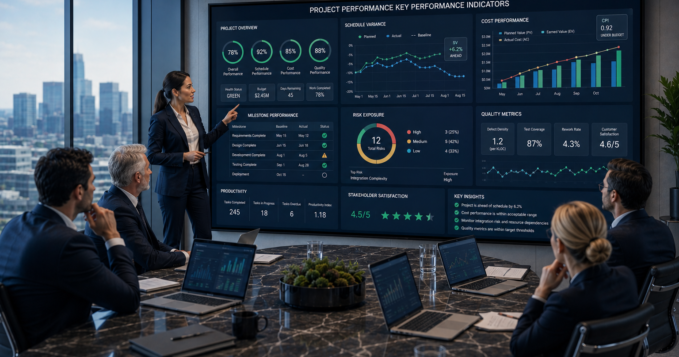
Project performance key performance indicators help teams measure delivery health, improve visibility, and support better decisions throughout the life of a project. Many projects produce regular status updates, but not all of them provide meaningful evidence about what is really happening. A project can appear busy while still drifting off schedule, overrunning cost, missing quality expectations, or building hidden risk. That is why good KPI design matters. The right indicators help leaders move beyond activity and understand actual performance.
Strong project performance key performance indicators are not just reporting tools. They are management tools. They help project managers, PMOs, sponsors, and governance groups see whether the project is progressing as expected, where control is weakening, and what action may be needed. Without that visibility, teams often discover problems too late or rely too heavily on subjective impressions instead of measurable signals.
The most useful KPI sets are not the biggest ones. They are the ones that focus attention on the few measures that reveal delivery health clearly. A good KPI should help answer practical questions: Are we on track? Are costs under control? Is scope stable? Are risks growing? Are issues being resolved fast enough? Are stakeholders still confident? When KPI reporting answers those questions well, project control improves.
If your organization is also improving broader delivery reporting, our project reporting best practices guide can help strengthen how KPI information is communicated.
Why Project Performance Key Performance Indicators Matter
Project performance key performance indicators matter because project leaders need more than general updates. They need evidence that helps them judge performance realistically. A status color alone is rarely enough. Useful KPIs show trends, expose early warning signs, and support governance discussions with more confidence.
Without strong project performance key performance indicators, organizations often face:
- weak visibility into real progress
- delayed recognition of problems
- poor quality of governance discussion
- inconsistent reporting across projects
- unclear accountability
- weak cost and schedule forecasting
- hidden risk growth
- less confident decision making
By contrast, good KPI discipline improves transparency and makes corrective action more timely. If your PMO is also strengthening governance quality, our project governance framework guide can help connect KPI reporting with stronger control.
1. Schedule Variance Shows Whether Timing Is Slipping
One of the most common project performance key performance indicators is schedule variance. It helps teams understand whether actual progress is ahead of, in line with, or behind the approved plan.
Schedule variance can highlight
- delayed tasks
- missed planned progress
- unrealistic timelines
- milestone pressure
- need for recovery action
Why this matters
Time slippage often affects many other areas, including cost, stakeholder confidence, and dependency management.
2. Cost Variance Helps Protect Financial Control
A key part of project performance key performance indicators is understanding whether spend is aligned with the approved budget.
Cost variance may reveal
- overspending trends
- underused funding
- poor forecasting
- cost impact of delays
- budget pressure from scope changes
Why this matters
Financial control is stronger when cost movement is visible early.
3. Milestone Achievement Measures Delivery Momentum
Milestones are important control points, so milestone achievement is one of the most practical project performance key performance indicators.
Useful milestone tracking shows
- milestones completed on time
- milestone slippage
- critical path pressure
- repeated delay patterns
- stage readiness concerns
Why this matters
Milestone trends help leaders see whether the project is maintaining momentum or gradually losing control.
4. Scope Stability Reveals Change Pressure
Scope stability is one of the most important project performance key performance indicators because frequent changes often create disruption across cost, schedule, and quality.
Scope-related KPI tracking may include
- number of approved changes
- number of pending changes
- trend in change volume
- impact of changes on delivery baselines
Why this matters
Uncontrolled scope movement is one of the clearest signs of weakening delivery control.
5. Risk Exposure Helps Show Threat Levels Over Time
Projects need more than a list of risks. Strong project performance key performance indicators should show whether exposure is rising, stable, or improving.
Risk KPI views may include
- number of high risks
- total risk exposure trend
- overdue mitigation actions
- repeated risk themes
- risk movement by phase
Why this matters
Risk becomes more manageable when leaders can see trends instead of isolated entries.
For broader perspective on practical project measurement, the Project Management Institute offers useful standards and resources.
6. Issue Resolution Speed Shows Responsiveness
Issue logs only help if issues move toward resolution. That is why issue resolution speed is one of the more useful project performance key performance indicators.
This KPI may track
- average days to resolve issues
- number of overdue issues
- unresolved critical issues
- recurring escalation themes
Why this matters
Slow issue resolution often signals weak ownership or overloaded teams.
7. Resource Utilization Helps Expose Capacity Pressure
Project performance key performance indicators should also show whether the team has the right capacity to deliver effectively.
Resource indicators may include
- overall capacity usage
- overallocated roles
- critical skill shortages
- contractor reliance
- idle or underused capacity
Why this matters
Resource imbalance creates hidden schedule and quality risk.
If your organization is also improving planning realism, our effective project scheduling guide can help support stronger time and capacity alignment.
8. Quality Metrics Show Whether Delivery Standards Are Being Met
A project can appear on track while quality is deteriorating underneath. Quality measures belong in any strong set of project performance key performance indicators.
Quality KPIs may include
- defect volume
- rework levels
- testing pass rates
- acceptance failure rates
- audit findings
Why this matters
Good progress without good quality often leads to later disruption and reputational damage.
9. Forecast Accuracy Improves Confidence in Reporting
Forecast accuracy is a valuable KPI because it shows whether the project team is estimating future outcomes realistically.
This may compare
- forecast versus actual milestone dates
- forecast versus actual spend
- forecast versus actual completion trends
Why this matters
Reliable forecasting improves trust in project reporting and leadership decisions.
10. Stakeholder Confidence Reflects Perceived Delivery Health
Not all project performance key performance indicators are purely numerical. Stakeholder confidence can be a powerful qualitative measure when tracked consistently.
Confidence may be assessed through
- sponsor feedback
- steering committee sentiment
- user readiness responses
- stakeholder survey results
Why this matters
Projects can weaken politically before they weaken operationally, so confidence matters.
For broader insight on communication and alignment, the Harvard Business Review article on communication offers useful perspective.
11. Benefits Progress Connects Delivery to Value
Projects should not only be measured by task completion. Strong project performance key performance indicators should also show whether expected value is being protected.
Benefits-related KPIs may include
- planned versus expected benefits
- readiness for benefit realization
- benefit risks
- adoption-related value indicators
Why this matters
A project that delivers outputs without value is not truly performing well.
12. Trend Analysis Makes KPIs More Useful
A single data point rarely tells the full story. One of the smartest ways to use project performance key performance indicators is to review trends over time.
Trend analysis helps teams
- spot gradual deterioration
- distinguish one-off issues from patterns
- judge whether recovery actions are working
- improve governance discussion quality
Why this matters
KPIs become more meaningful when they show movement, not just isolated numbers.
Common Project KPIs to Include in Reporting
When designing project performance key performance indicators, teams usually benefit from a balanced set of measures.
Typical KPI categories include
- schedule health
- cost health
- milestone performance
- scope stability
- risk exposure
- issue resolution
- resource usage
- quality performance
- stakeholder confidence
- benefits progress
Common Mistakes in KPI Design
Even experienced teams can weaken project performance key performance indicators by choosing the wrong measures or reporting them poorly.
Tracking activity instead of performance
Being busy does not always mean the project is healthy.
Using too many KPIs
Too many metrics create noise and dilute attention.
Ignoring trends
One-time figures can hide worsening patterns.
Measuring what is easy instead of what matters
Useful KPIs should support decisions, not just fill dashboards.
Reporting without action
If KPI reporting never changes decisions, it is not doing enough.
Best Practices for Better KPI Tracking
Teams usually strengthen project performance key performance indicators when they apply a few practical habits.
Keep measures relevant
Every KPI should help answer an important management question.
Keep reporting consistent
Trends only become useful when measures are tracked regularly.
Combine quantitative and qualitative insight
Some of the most important warning signs are not purely numerical.
Link KPIs to governance action
Reporting should lead to conversation and follow-up.
Review KPI relevance over time
Projects evolve, so the KPI set may need adjustment.
Project Performance Key Performance Indicators Checklist
Use this checklist to improve project performance key performance indicators:
- track schedule variance
- review cost variance regularly
- monitor milestone achievement
- measure scope stability
- assess risk exposure trends
- track issue resolution speed
- monitor resource utilization
- include quality indicators
- review forecast accuracy
- assess stakeholder confidence
- connect KPIs to benefits progress
- analyze trends over time
This checklist helps make project performance key performance indicators more practical, focused, and useful for real project control.
Final Thoughts
Project performance key performance indicators are essential because projects need more than narrative updates and traffic-light status reports. They need evidence that shows where delivery is healthy, where it is weakening, and where decisions are needed. Good KPIs improve visibility, strengthen accountability, and make governance conversations more useful.
The best KPI sets are not the largest. They are the ones that reveal project health clearly and support timely action. When organizations use project performance key performance indicators well, delivery control becomes more transparent, more realistic, and more effective.
Frequently Asked Questions
What are project performance key performance indicators
Project performance key performance indicators are the measures used to assess project health, progress, cost control, schedule performance, risk, quality, and overall delivery effectiveness.
Why are project KPIs important
They are important because they improve visibility, support better decision making, and help leaders detect delivery problems earlier.
What are common project performance KPIs
Common KPIs include schedule variance, cost variance, milestone achievement, scope change, risk exposure, issue resolution speed, quality measures, and stakeholder confidence.
How do you choose project KPIs
Choose project KPIs by focusing on measures that reflect delivery health, support decisions, remain understandable, and show meaningful trends over time.
How many KPIs should a project use
Most projects benefit from a focused KPI set rather than a very large one. A smaller number of relevant measures is usually more useful than a crowded dashboard.